Why Some Businesses Print Money for Decades
Warren Buffett spent a career boiling investing down to one core question: does this business have a moat?
Not a temporary advantage. Not a product lead that a well-funded competitor could replicate in two years. A structural competitive advantage — something baked into the economics of the business itself — that protects profits from erosion regardless of who tries to compete.
He called it the economic moat. And every serious long-term investor should understand it before buying a single share.
The term comes from a literal moat — the water-filled trench surrounding a castle that makes it defensible. An economic moat works the same way: it makes a company's competitive position defensible even when well-capitalized rivals try to storm the walls.
The practical result of a wide moat: the company earns returns on capital far above what competitors can match, and does so consistently for years or even decades. That predictability is worth a significant premium in valuation — and it means investors can hold through volatility without worrying that the earnings will deteriorate.
The 5 Types of Economic Moats
Not all moats are created equal, and they don't all look the same in financial statements. Here are the five most important types, with examples you can study.
1. Network Effects
A network effect moat exists when the product becomes more valuable as more people use it. The canonical examples:
- Visa and Mastercard: The payment network is valuable to merchants because cardholders use it, and valuable to cardholders because merchants accept it. Every new merchant added makes the card more useful; every new cardholder makes the network more attractive to merchants. Trying to launch a competing payment network from scratch means simultaneously convincing merchants AND cardholders to switch — nearly impossible.
- Meta (Facebook/Instagram): Your friends are on Facebook. That's the moat. A technically superior social network with no friends on it is worth nothing to you.
- LinkedIn: Professional networks become more valuable as more professionals in your industry are represented. The switching cost is the loss of your professional graph.
Network effects are among the most durable moats because they self-reinforce. The leader's advantage grows as the network grows.
What to look for in financials: High gross margins, low marginal cost per new user added, revenue that scales faster than costs (operating leverage), and customer acquisition costs that fall as the network grows.
2. Switching Costs
Switching cost moats arise when the cost — financial, operational, or psychological — of leaving a product is high enough that customers stay even if a competitor offers a somewhat better or cheaper alternative.
- Salesforce: Enterprise CRM systems are deeply embedded in a company's sales workflow, customer data, and internal processes. Switching to a competitor means migrating years of customer data, retraining the entire sales team, rebuilding integrations, and accepting months of disruption. The cost of staying with Salesforce — even at a premium — is almost always lower than the cost of switching.
- Oracle database: Hospital systems, financial institutions, and manufacturers have run on Oracle for decades. The switching cost isn't just licensing — it's the risk of migrating mission-critical systems, the time to retrain staff, and the cost of rebuilding custom applications. Oracle charges premium prices because customers weigh those costs and rationally choose to stay.
- Adobe Creative Suite: Designers who have spent years mastering Photoshop and Illustrator face a steep learning curve switching to competitors. The switching cost here is psychological and productivity-based, not financial.
What to look for in financials: Recurring revenue models (subscriptions, maintenance contracts), high renewal rates (above 90%), net revenue retention above 100% (existing customers spend more over time), and customer lifetime value that grows over years without significant increases in sales and marketing.
3. Intangible Assets
Intangible asset moats come from brands, patents, or regulatory licenses that competitors cannot easily replicate.
- Brands (Coca-Cola): Coca-Cola's formula is a trade secret, but the real moat is the brand. Blind taste tests consistently show consumers prefer Pepsi — but at retail, they consistently buy Coke. The brand represents 150+ years of emotional association built through marketing investment that would cost billions to replicate. Coke charges a price premium in every market it enters.
- Patents (pharmaceutical companies): Eli Lilly's Mounjaro/Zepbound has a patent moat protecting its GLP-1 mechanism until the mid-2030s. During the protected period, Lilly can charge prices that generate enormous returns on the R&D investment. The moat expires on a known date — which is why patent cliffs are major valuation events for drug stocks.
- Regulatory licenses: A waste disposal company with regulatory permits in a given region has an intangible moat — getting new permits is extraordinarily difficult, so competitors cannot simply enter the market. Cable companies historically had franchise monopolies in specific geographies. Casino operators hold gaming licenses that new entrants cannot obtain.
What to look for in financials: Pricing power (gross margins that are stable or expanding even during inflationary periods), advertising spend as a percentage of revenue declining over time (the brand is self-reinforcing), and revenue that holds up during economic downturns (demand inelasticity).
4. Cost Advantages
Cost advantage moats arise when a company can produce its goods or services at a meaningfully lower cost than competitors, allowing it to either undercut on price or earn superior margins at competitive prices.
- Walmart: Walmart's supply chain, distribution network, and purchasing scale allow it to buy goods at lower prices than any competitor. It passes those savings to customers in the form of lower prices, which drives volume, which reinforces the purchasing scale. The cycle is nearly impossible for a new entrant to break without already having comparable volume.
- Costco: Costco's business model — low prices on a curated selection, funded by high-margin membership fees — creates a cost advantage through a different mechanism. Members pay to shop there and receive lower prices in return, creating loyalty that insulates Costco from both Amazon and traditional retail.
- GEICO: Auto insurance is largely a commodity, but GEICO built a cost advantage through direct-to-consumer distribution (no agent commissions) and massive investment in actuarial pricing. Lower costs let it offer lower premiums, which attracts better-risk customers, which allows even lower premiums — a virtuous cycle.
What to look for in financials: Gross margins at or above the industry average despite lower prices, capital investment in automation and supply chain rather than growth, and operating margins that expand with scale rather than remaining flat.
5. Efficient Scale
Efficient scale moats exist in markets where the total market size is limited and supporting one or a few competitors is economically efficient, but adding a new competitor would make the market unprofitable for everyone.
- Local utilities: A water utility serving a mid-sized city has invested billions in infrastructure. A second water utility competing in the same geography would need the same investment but would split the customer base — making both utilities unprofitable. The market naturally supports only one provider. This is why utilities are regulated monopolies.
- Railroads (BNSF, Union Pacific): Building a competing railroad along an existing route would cost tens of billions and take decades. The existing operator earns returns on the sunk infrastructure cost with no meaningful competition along specific routes. Buffett bought BNSF's parent Burlington Northern for this reason — he called it "an all-in wager on the economic future of the United States."
- Specialty industrial gases (Air Products, Linde): Industrial gas plants are built next to large industrial facilities and connected by pipeline. The customer built their processes around one supplier's plant. No competitor would build a second plant to serve the same customer — the market only supports one.
What to look for in financials: High return on assets concentrated in specific geographies, capital intensity that serves as a barrier to entry, and revenue that is highly predictable and recurring with no commodity pricing risk.
ROIC: The Ultimate Financial Test for Moats
Every type of moat ultimately shows up in one metric: Return on Invested Capital (ROIC).
ROIC measures how efficiently a company turns invested capital (debt + equity) into profits. The formula:
code-highlightROIC = Net Operating Profit After Tax (NOPAT) / Invested Capital
Companies without moats earn ROIC around the cost of capital — typically 8-12%. Competition erodes returns until they're just above the threshold where it's worth operating.
Companies with wide moats earn ROIC of 15%, 25%, 40%, or more — sustainably, for years. Visa has earned 25%+ ROIC for a decade. Microsoft consistently earns above 30%. Coca-Cola has rarely fallen below 20%.
The test of moat strength is not one year of high ROIC — it's 10+ years of high ROIC. To screen for wide-moat businesses:
| Metric | Wide Moat Signal | How to Check |
|---|---|---|
| ROIC (10-year average) | >15% | Fundamental charts / screener |
| Gross margin trend | Stable or expanding | Income statement, multi-year |
| Net revenue retention | >100% (for SaaS) | Investor presentations |
| Customer churn rate | <5% annually | Earnings calls |
| Pricing power | Can raise prices above inflation | Annual price increase history |
How Moats Erode — and Why You Must Keep Watching
Identifying a moat is not a one-time exercise. Moats erode when:
Technology disrupts the moat's foundation. Blockbuster had a geographic moat — you needed a local store to rent videos. Netflix made geography irrelevant. Blockbuster's moat evaporated in a few years as broadband penetration reached critical mass.
New technology eliminates switching costs. Cloud computing dramatically reduced Oracle's switching cost moat in mid-market enterprises. Moving data to a cloud database became easier and cheaper than before. Oracle adapted by moving its own products to cloud, but the moat narrowed.
The regulatory basis changes. Newspaper classifieds had a near-monopoly on local job listings, used cars, and real estate. The internet eliminated that regulatory and distribution barrier. Craigslist disrupted the model without even charging for listings.
The brand loses relevance. Kodak had one of the most recognized brands in the world and a strong patent moat in film. Digital photography didn't just compete with Kodak's products — it made the category irrelevant. The brand had no meaning in a world without film.
Signs to watch for moat erosion:
- ROIC declining over 3+ consecutive years
- Revenue growth decelerating while marketing spend accelerates
- Customer churn rising or renewal rates dropping
- Pricing power eroding (margin compression despite stable input costs)
- A technology shift reducing the relevance of the moat's foundation
Using the Screener to Find Moat Candidates
You don't need to pay for Morningstar's moat ratings to identify moat candidates. Use the Stock Alarm screener with filters that proxy for moat strength:
| Filter | Value | Moat Signal |
|---|---|---|
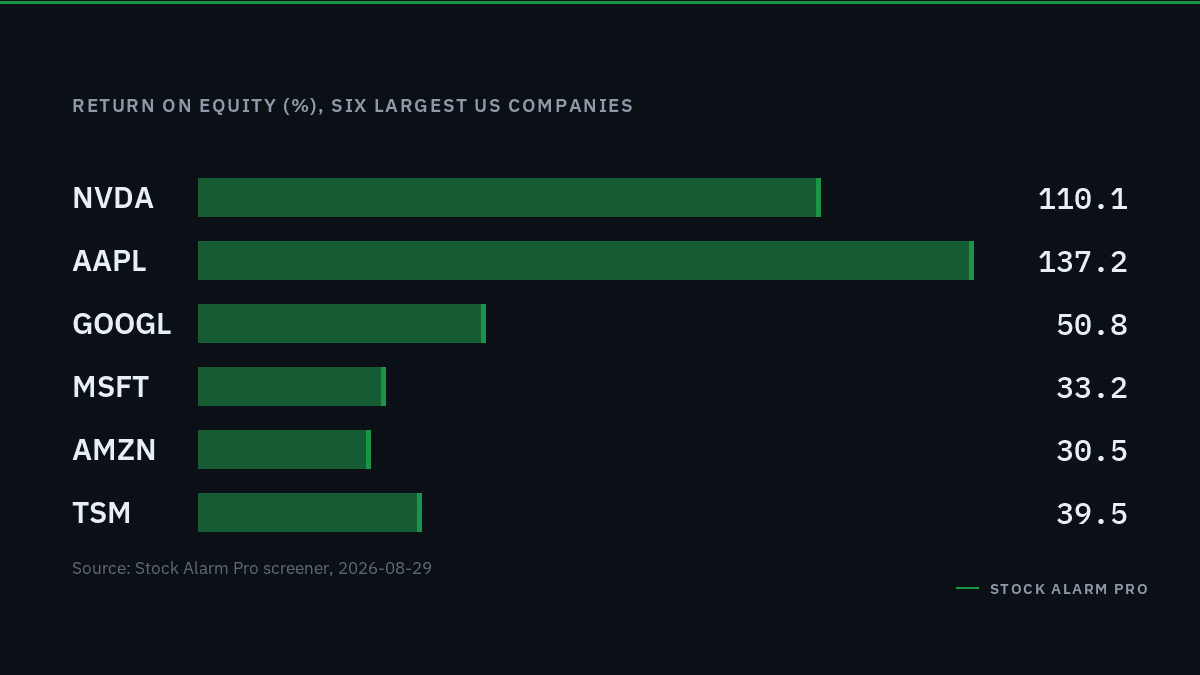
| Return on Equity | >20% (10-year) | Consistent above-average returns |
| Gross Margin | >40% | Pricing power and scale advantage |
| Debt to Equity | <0.5 | Not borrowing to fund returns |
| Revenue Growth (5-year) | >10% | Growing into the moat |
| Operating Margin | >20% | Converts revenue to profit efficiently |
Stocks that consistently clear all five filters are disproportionately likely to have structural competitive advantages rather than temporary favorable conditions.
Setting Alerts Around Moat-Degrading Events
Long-term moat investing means buying and holding through volatility — but it also means watching for events that signal the moat is being challenged.
Set these alerts on your wide-moat positions:
Earnings alerts: A sustained compression in gross margin for a company with a pricing-power moat is a red flag. Set an alert to notify you when gross margin drops more than 2 percentage points year-over-year.
Analyst rating alerts: When multiple analysts who have covered a wide-moat company for years downgrade simultaneously, it often reflects a moat reassessment. Track unusual consensus shifts.
Volume alerts: Unusual institutional selling in a wide-moat company that has been stable for years warrants investigation. Large funds don't exit moat positions casually.
Regulatory alerts: For moats built on regulatory licenses or patents, monitor SEC filings and earnings calls for any mention of regulatory challenge, patent expiry, or competitive entry that regulators are considering.
The Most Important Question in Investing
Peter Lynch called it the "cocktail party test." Buffett called it the moat. Charlie Munger called it the "sustainable competitive advantage." The words differ; the question is the same:
Why will this company be profitable in 10 years, when well-capitalized competitors have had a decade to try to take its business?
The answer — if there is one — is almost always one of the five moat types above. If you can't articulate a specific structural reason why a company's profits are durable, you're not making an investment. You're making a bet.
The screener finds the financial fingerprints. The moat framework explains why those fingerprints exist. Together, they're the foundation of every great long-term investment in market history.