Stock Settlement Explained: What T+1 Means and When Your Cash Is Really Available
T+1 settlement means a US stock trade finalizes one business day after you place it. Learn how settlement works, why it matters for selling, withdrawing cash and dividends, and what a settlement date is not.
You click buy, the order fills, and the position appears in your account. It feels finished. Behind the scenes, though, the trade is not final yet. Settlement is the step where the shares officially move to you and the cash officially moves to the seller.
Most investors never think about it until a broker message says "unsettled funds" or a withdrawal is blocked. This guide explains what settlement is, what T+1 means, and where it affects real decisions.
Trade Date vs Settlement Date
Two dates matter for every trade:
- Trade date (T): the day your order executes.
- Settlement date: the day the trade is finalized and ownership and payment are exchanged.
Under T+1, the settlement date is one business day after the trade date. A buy filled on Monday settles on Tuesday. A buy filled on Friday settles on the following Monday, because weekends are not business days. Market holidays are skipped the same way.
The US moved from T+2 to T+1 on May 28, 2024. Before that, a Monday trade settled on Wednesday.
Why Settlement Exists
When you buy 10 shares, someone sells you those 10 shares, and a clearing system matches both sides. Settlement is the clearing step that delivers the shares to your broker and the cash to the seller's broker. The gap between trade and settlement gives the system time to confirm, match and reconcile millions of trades.
A shorter cycle reduces the time both sides are exposed to the risk that the other side fails to deliver. That is the main reason regulators pushed for T+1.
What Settlement Changes for You
You can still sell right away
You do not need to wait for settlement to sell. Once your buy fills, you are the owner for trading purposes. Selling a position the same day you bought it is allowed, subject to account rules such as the pattern day trader rule for margin accounts.
Cash availability
Sale proceeds are "unsettled" until the sale settles. Brokers handle this differently:
- Many let you reuse the proceeds right away to buy something else.
- Most hold bank withdrawals until the cash is settled.
- Cash accounts are stricter than margin accounts (see below).
Good faith violations in cash accounts
In a cash account, buying a stock with unsettled proceeds and then selling that new stock before the original sale settles can trigger a good faith violation. Repeated violations can lead the broker to restrict the account for a period. Margin accounts generally avoid this because the broker lends against the unsettled amount, but margin brings its own risks, covered in margin trading explained.
Dividends
Settlement timing is why the ex-dividend date is what it is. With T+1, the ex-dividend date and the record date fall on the same day. To receive the next dividend, you need to buy the stock before the ex-dividend date, not on it.
What Settlement Is Not
- It is not a delay in owning the stock. Price gains and losses are yours from the moment the order fills.
- It is not the same as the order filling. A fill is the execution. Settlement is the back-office completion.
- It does not apply to everything the same way. Options, for example, settle the next business day, and some products such as mutual funds have their own schedules. Check the product's rules.
Practical Tips
- Before a holiday weekend, count business days. A trade right before a long weekend can take longer to settle than you expect.
- If you need cash for a bill or a down payment, sell early enough that the proceeds settle before you need to transfer them out.
- In a cash account, avoid chaining trades on unsettled money.
- Around dividends, check the ex-dividend date, not just the payment date.
Where Alerts Fit
Settlement timing makes the order in which you act more important. If you plan to sell a position to raise cash, a price alert tells you when your target is reached, so you can sell with enough time for the money to settle before you need it. In Stock Alarm Pro you can set a price alert on any stock and get notified when it crosses your level, instead of watching the screen. See how to set stock price alerts.
Bottom Line
T+1 means a US stock trade settles one business day after the trade date. You can trade the shares immediately, but formal ownership and cash movement finish a day later, which matters for withdrawals, cash accounts and dividend eligibility. Know your broker's rules on unsettled funds, and plan sales ahead when you need the cash.
Related Reading
Stock Alarm on your phone
Set price alerts and follow the stocks you track in the Stock Alarm app for iPhone and Android.
Want alerts like these? Get started free.
Join 295,000+ traders using Stock Alarm to stay ahead of the market.
See it work — free
Track markets, screen stocks, and set price alerts with Stock Alarm Pro. Explore the live markets free — no account needed. Trusted by 295,000+ investors.
S&P 500 Screener
Filter by metrics, fundamentals
Price Alerts
Never miss a move
35+ Global Markets
Stocks, crypto, futures
AI Analysis
Ask questions, get answers
Related Articles
Stop-Loss Orders Explained: How to Set the Right Stop Loss
Learn how stop-loss orders work, the difference between stop-loss and stop-limit orders, how to calculate the right stop level, and 5 strategies to protect your trades.
Stock Order Types Explained: Market, Limit, Stop, and More
Learn how different stock order types work, when to use market vs limit orders, how stop-losses protect your portfolio, and advanced order types for better execution.
Dividend Yield Explained: How to Calculate It and When a High Yield Is a Warning
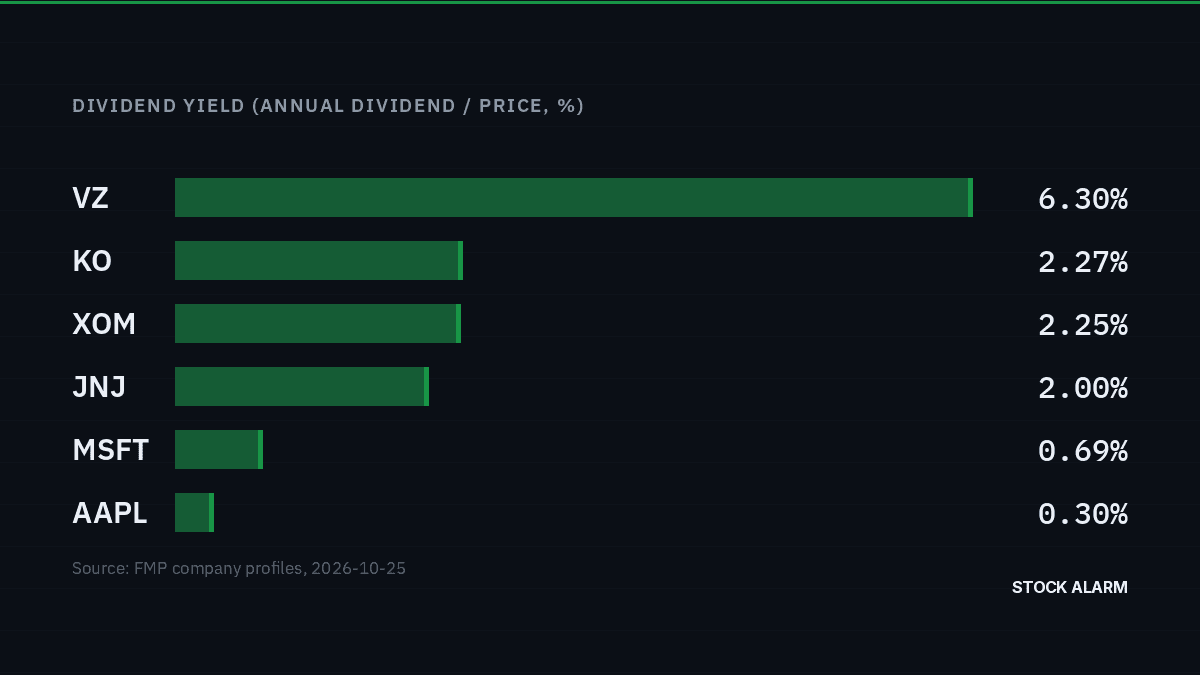
Dividend yield is annual dividends divided by share price. Learn the formula, see real yields for KO, XOM, VZ, JNJ, AAPL and MSFT, and why a very high yield can signal trouble.