A stock you own gets a notice from its exchange, and the headline says "delisting." Does it mean the shares are worthless? Not exactly. The word sounds final, but delisting is a process with rules, deadlines and several possible outcomes.
This guide explains why stocks get delisted, how long the process takes, what happens to your shares, and how to spot trouble early.
What Is Delisting?
Delisting is the removal of a stock from a major exchange such as the Nasdaq or the New York Stock Exchange. Once a stock is delisted, it can no longer trade on that exchange. Companies can leave on their own (a voluntary delisting) or be removed because they stopped meeting the exchange's rules (an involuntary delisting).
Your ownership does not change. You still hold the same number of shares. What changes is where and how easily they trade.
Why Stocks Get Delisted
Exchanges set minimum standards so that listed stocks are reasonably transparent and liquid. The most common reasons a company falls short are:
| Reason | What triggers it |
|---|---|
| Low share price | Bid or closing price stays under $1.00 for 30 consecutive business days (Nasdaq) or 30 trading days (NYSE) |
| Late filings | Missing a 10-K or 10-Q deadline with the SEC |
| Too few shareholders or too little market value | Falls below the exchange's minimum for public float or number of holders |
| Bankruptcy | Chapter 7 or Chapter 11 filing |
| Corporate governance failures | Missing audit committee or board independence requirements |
| Merger or going private | The company is acquired and its shares are cancelled |
Not every delisting is bad news. When a company is bought, its stock is delisted because the shares no longer exist as a separate security. Shareholders usually receive cash or shares of the buyer.
The Minimum Bid Price Rule
The most frequent cause for ordinary stocks is the $1 minimum bid price rule. On Nasdaq, if a stock's bid closes below $1.00 for 30 consecutive business days, the company receives a deficiency notice. The standard timeline looks like this:
- 30 consecutive business days below $1.00 triggers a notice.
- The company then gets 180 calendar days to regain compliance, which means closing at $1.00 or higher for at least 10 consecutive business days.
- A company on the Nasdaq Capital Market may qualify for a second 180-day period if it meets other listing standards and says it will fix the problem, for example with a reverse stock split.
- If the company still falls short, the exchange issues a delisting determination, which the company can appeal to a hearings panel.
Exchanges have tightened parts of this process in recent years, especially for companies that have already done a reverse split, so always read the company's own filing for its exact deadline. The NYSE uses a similar test: an average closing price under $1.00 over 30 trading days, with six months to cure.
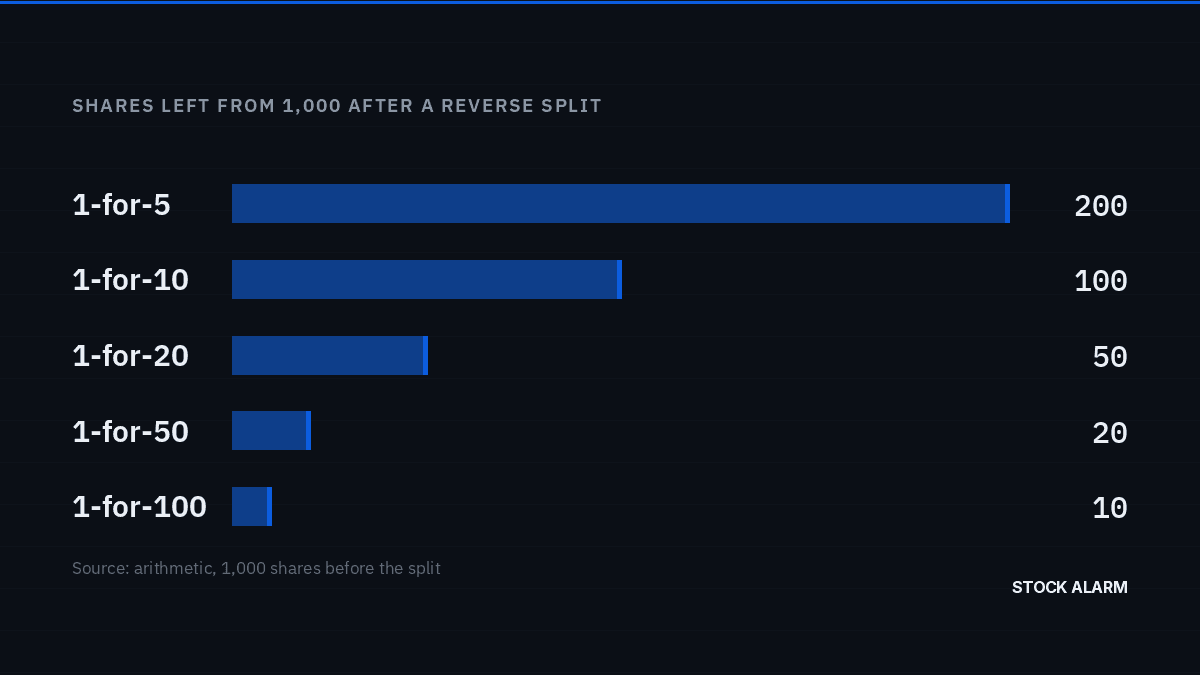
Many companies respond with a reverse stock split, which raises the quoted price without changing what the company is worth. That cures the rule on paper. It does not fix the underlying business, which is why stocks that split to stay listed often keep falling.
What Happens to Your Shares
When a stock is delisted, the typical sequence is:
- Notice. The company must disclose the exchange's decision, usually in an 8-K filing.
- Last day of exchange trading. The stock's final listed session is announced.
- Over-the-counter trading. Shares often begin quoting on OTC markets. Liquidity is thinner, bid-ask spreads are wider, and prices can jump around on small volume.
- Broker restrictions. Some brokers limit buying of OTC shares, charge extra fees, or only allow you to close the position.
In the case of bankruptcy, the common stock usually ranks last in line behind creditors and bondholders. Delisted shares of a company in liquidation can end up worth little or nothing. In a merger, the delisting is simply the end of the stock's life and you are paid according to the deal terms.
Warning Signs Before a Delisting
Delistings rarely arrive without notice. Common early signals are:
- A price creeping toward $1.00. The rule applies to a sustained period, so a drop under $1 is a clock starting, not an end.
- A deficiency notice in an 8-K. Search the company's SEC filings for "Item 3.01" (notice of delisting or failure to satisfy a listing rule).
- Late 10-K or 10-Q filings (an NT 10-K or NT 10-Q form).
- Going-concern language from the auditor.
- Heavy dilution from repeated share sales. See our guide to stock dilution.
- Unusual volume with no clear news, which can reflect informed selling.
None of these guarantees a delisting. Several together deserve a closer look at your position size.
Using Alerts to See It Coming
Because delisting is a slow process with several visible checkpoints, it is a good fit for alerts. With Stock Alarm Pro you can:
- Set a price alert at $1.50 or $1.25 on a low-priced holding, so you hear about the slide toward the $1 rule before the 30-day clock begins.
- Set a price alert at $1.00 as your decision point: hold, trim or sell.
- Add unusual volume alerts to catch heavy selling.
- Follow filings and news alerts on your holdings so an 8-K deficiency notice reaches you the day it is filed instead of weeks later.
- Use the stock screener to see which of your watchlist names trade below $5, where listing-rule risk is concentrated.
Set a free price alert in Stock Alarm Pro on any holding trading near the $1 line.
Key Takeaways
- Delisting removes a stock from a major exchange. It does not cancel your shares.
- The most common trigger is a bid price under $1.00 for 30 consecutive business days, followed by a 180-day cure period (sometimes a second one).
- Delisted stocks usually trade over the counter, with lower liquidity and wider spreads.
- Bankruptcy-related delistings are the dangerous ones: common stock is paid last.
- Price, filing and volume alerts let you act at the warning stage instead of the last-day-of-trading stage.
This article is for educational purposes and is not investment advice. Listing rules change; confirm current requirements with the exchange and the company's SEC filings.